



Ministry of Finance · FTA · EmaraTax · Cabinet of the UAE
Official UAE eInvoicing documents
Binding Ministerial / Cabinet decisions and MoF programme packs, hosted for fast download, always cross-check on mof.gov.ae.
Legislation (binding decisions)
Scope (MD 243), implementation phases (MD 244 + MD 66), ASP accreditation (MD 64 + MD 56), and administrative penalties (Cabinet Decision 106). Service providers: ASP accreditation checklist.
Who must use UAE eInvoicing (MD 243 of 2025)
Ministry of Finance, UAE
Download PDFImplementation phases and deadlines (MD 244 of 2025)
Ministry of Finance, UAE
Download PDFUpdated large-taxpayer ASP deadline (MD 66 of 2026)
Ministry of Finance, UAE
Download PDFASP eligibility and accreditation rules (MD 64 of 2025)
Ministry of Finance, UAE
Download PDFUpdated ASP eligibility criteria (MD 56 of 2026)
Ministry of Finance, UAE
Download PDFeInvoicing violations and penalties (Cabinet Decision 106)
Cabinet of the UAE
Download PDFMD 244 · amended by MD 66
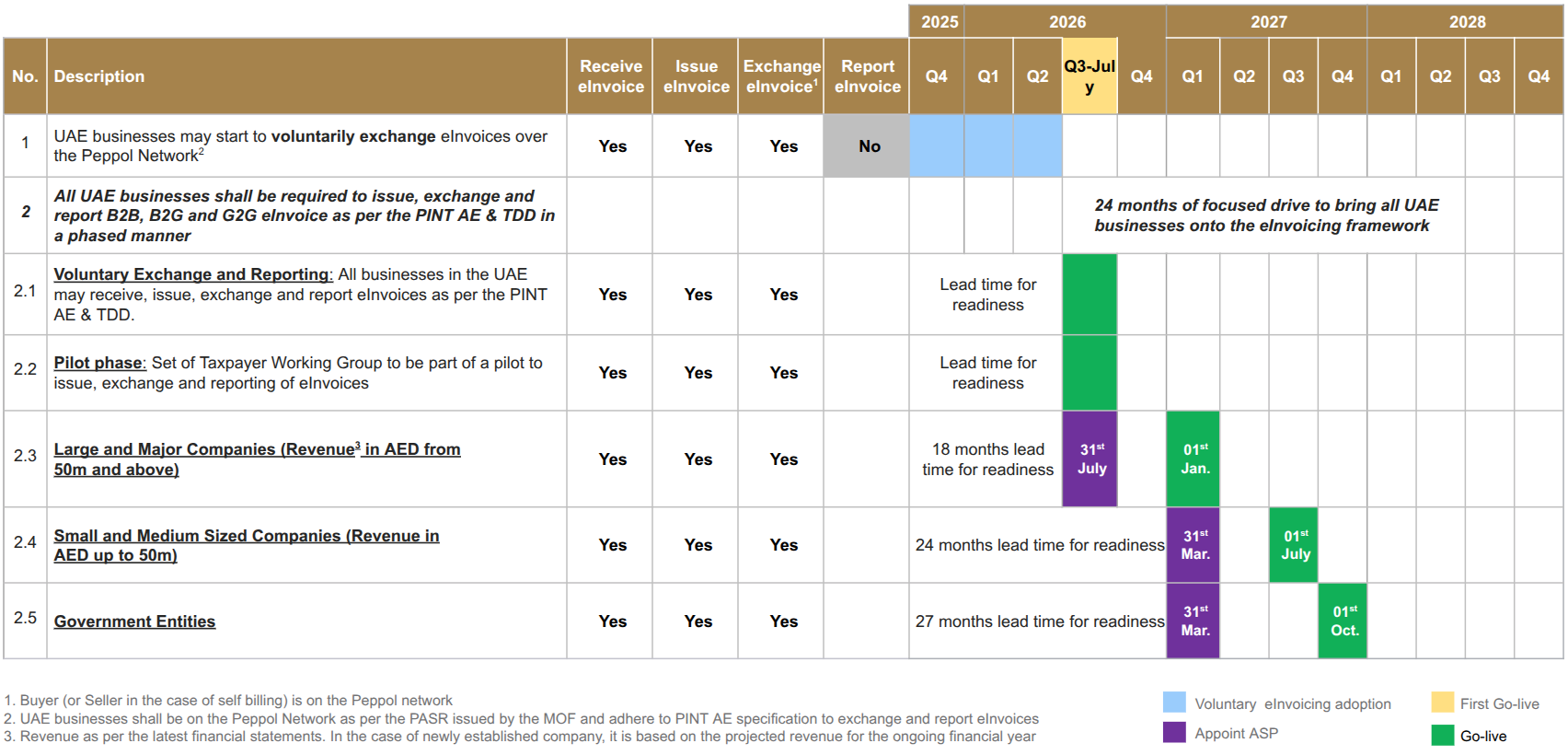
Mandatory implementation timeline
- 1
1 Jul 2026
Pilot & voluntary
Pilot Programme starts. Voluntary implementation opens under full technical rules.
- 2
30 Oct 2026
Large taxpayers: ASP
Revenue ≥ AED 50M must appoint an Accredited Service Provider (MD 66).
- 3
1 Jan 2027
Large taxpayers: go-live
Revenue ≥ AED 50M: mandatory Electronic Invoicing System.
- 4
31 Mar 2027
SME & government: ASP
Revenue < AED 50M and Government Entities: ASP appointment deadline.
- 5
1 Jul 2027
SME go-live
Revenue < AED 50M: mandatory implementation.
- 6
1 Oct 2027
Government go-live
Government Entities: mandatory implementation.
B2C transactions remain outside the Electronic Invoicing System until the Minister determines otherwise (MD 244, Article 5(2)). Confirm the latest text on mof.gov.ae.
From mof.gov.ae
Official MoF timeline graphic
Programme guidance (MoF)
How the UAE eInvoicing programme works
Ministry of Finance, UAE
Download PDFOfficial Electronic Invoicing Guidelines
Ministry of Finance, UAE
Download PDFRequired fields on electronic tax invoices
Ministry of Finance, UAE
Download PDFHow to choose an Accredited Service Provider
Ministry of Finance, UAE
Download PDFHow to use the ASP accreditation portal
Ministry of Finance, UAE
Download PDFMoF Guidelines V1.1 · DCTCE
UAE Electronic Invoicing framework
Clean coded recreation of the official 5-corner model. Invoice data moves over OpenPeppol (C1→C2→C3→C4), with parallel tax data reporting into Corner 5 and the Central Data Platform.
Corner 1
Supplier · Send
Enters invoice data and starts via OpenPeppol ASP.
Corner 2
ASP · Validate & transmit
Validates PINT AE / standards, confirms ID, sends securely.
Corner 3
ASP · Collect, validate & deliver
Receives on Peppol, validates, delivers to buyer format.
Corner 4
Buyer · Receive
Business software populated from their ASP.
Corner 5
FTA / MoF · Central Data Platform
Tax Data from C2 & C3 collected, processed and stored.
- 1
Supplier (C1) submits invoice data to their ASP (C2).
- 2
C2 validates and converts to UAE standard XML (PINT AE).
- 3
C2 transmits XML to the buyer’s ASP (C3) over OpenPeppol.
- 4
In parallel, C2 reports Tax Data to Corner 5 (FTA / MoF).
- 5
C3 validates, confirms to C2, and delivers to the buyer (C4).
- 6
C3 also reports Tax Data to Corner 5; confirmations flow back.
Live official websites
Prefer guided explainers? Read our UAE eInvoicing blog for guides on penalties and scope and exclusions.